











Do With, Not To: Building the Digital Infrastructure for Neighbourhood Health

By Dr Minal Bakhai • 3rd June 2026 • 7-Minute Read
Minal is a practicing GP in Harlesden, Deputy CEO and Chief Clinical and Strategy Officer at Blinx and former Director of Primary Care Transformation and SRO for the National Neighbourhood Health Implementation Programme for the NHS in England
The most important moments in health and care rarely feel like transformation.
They look like a conversation at the right time, with the right people, about what really matters to someone.
Everything else should create the conditions for that moment.
Walter's Story
Walter is 90 years old.
Over time, his world quietly contracted. Loneliness grew. Depression followed. Mobility declined. Cognition worsened. Dehydration deepened. Emergency calls increased.
On paper, his care looked complex.
But the trajectory was not inevitable.
The turning point was not a test, a scan, or a referral.
It was understanding what had changed in his everyday life.
A tremor had worsened. In hospital, a medication was stopped after a falls risk assessment. Clinically reasonable. Systemically incomplete. Practically devastating.
Without it, Walter could no longer eat or drink confidently. Something simple – social, human – disappeared.
He stopped going out.
In his words, he felt like “a garbage can”. And he was clear: he would rather have quality of life than just more time.
That conversation changed everything.
Together, we decided to restart the medication. A walking aid and home adaptations were put in place. Social care and VCFSE support were coordinated around him.
Nothing dramatic. But everything transformed.
His confidence returned. Then his routine. Then his relationships.
He didn’t need escalation. He didn’t need a new pathway. He didn’t need institutional care.
He needed coherence around what mattered to him.
And that is the point.
The most powerful interventions in healthcare are often not interventions at all – but decisions made with people, not for them.
Increasingly, those conversations are harder to create. Not because people don’t care – but because systems fragment the conditions that make them possible.
And these are not simply clinical decisions.
They are commissioning decisions too – shaping what gets funded, what gets prioritised, and what becomes possible in people’s lives.
Healthcare rarely fails because of effort.
It fails when systems lose coherence around the person.
That tension is what led me to Blinx.
To continue the mission and help people to live: Gloriously. Ordinary. Lives.
The real pressure is not demand. It is fragmentation
We talk about pressure in health systems as rising demand.
But much of that demand is created by the system itself.
Failure demand describes what happens when need is not met the first time.
A community centre closes. A child misses early help. A carer chases support. Deterioration becomes a crisis. None of this is new demand.
It is system-generated work.
What looks like rising demand is often fragmentation.
Because failure demand lives at the boundaries — between services, organisations, digital systems, accountabilities, and communities.
And those boundaries are exactly where neighbourhood health is meant to work.
Yet too often, they are where it breaks.
The system becomes busy coordinating itself instead of supporting people.
Fragmentation creates friction everywhere: for people trying to navigate services, for staff trying to coordinate care, and for organisations trying to work together around the same population.
And the consequences are not evenly distributed.
Poor communication, inaccessible systems, people re-telling their story, unclear pathways, and administrative complexity disproportionately affect marginalised communities, people with lower health confidence, and those already least well served by the system.
And so people withdraw. They delay seeking help. They lose trust. And they stop engaging with the system altogether.
It creates harm.
Why Digital Matters
This is where pressure becomes visible in daily work.
Across the system, clinicians spend up to half their time on administrative and system-related tasks rather than direct care.
This is not just paperwork.
It is navigating systems. Reconstructing fragmented information. Managing processes. Completing tasks across multiple platforms. Re-entering data. Chasing clarity that should already exist.
Time that displaces relational care.
Time to listen. To explain. To understand context. To build trust. To make shared decisions. To ask what matters.
When that time disappears, something predictable happens: care becomes more transactional.
Systems become busier – but less effective.
More reactive. More procedural. More risk averse. More activity.
Less human. Less coherent. Less responsive. Less value.
We have spent two decades redesigning organisational structures in pursuit of integration.
Strategic Health Authorities. PCTs. CCGs. ICSs. NHS England. And now another reset.
But structure alone does not create coherence.
Coherence is relational and operational.
It lives in whether people, teams, services, and communities trust each other and can actually work together around the same person, family and household in real time.
This is where digital matters.
But only if it changes the structure of the work itself – and helps reshape the culture that sits beneath it.
Not digitising fragmentation. But removing it.
Making the invisible, visible.
Redefining whose knowledge is valued.
Strengthening neighbourhood working and treating system partners as equals.
Recognising that the future of reform is not just about fixing the NHS – but about building healthier places and communities.
Enabling time, attention, judgement, and relational capacity to return to where they belong: understanding people in the context of their lives.
Because better care starts with better understanding and better partnerships.
From Strategy To Practice
There is a major shift underway: the move towards a Single Patient Record.
A coherent view of the person across the whole system. Not episodes. Not silos. A continuous understanding of need, risk, and what matters.
But a shared record alone does not create coherence.
Because coherence is not simply seeing information.
It is developing a shared understanding, acting on it together, and sharing accountability.
What is missing is not ambition. It is infrastructure.
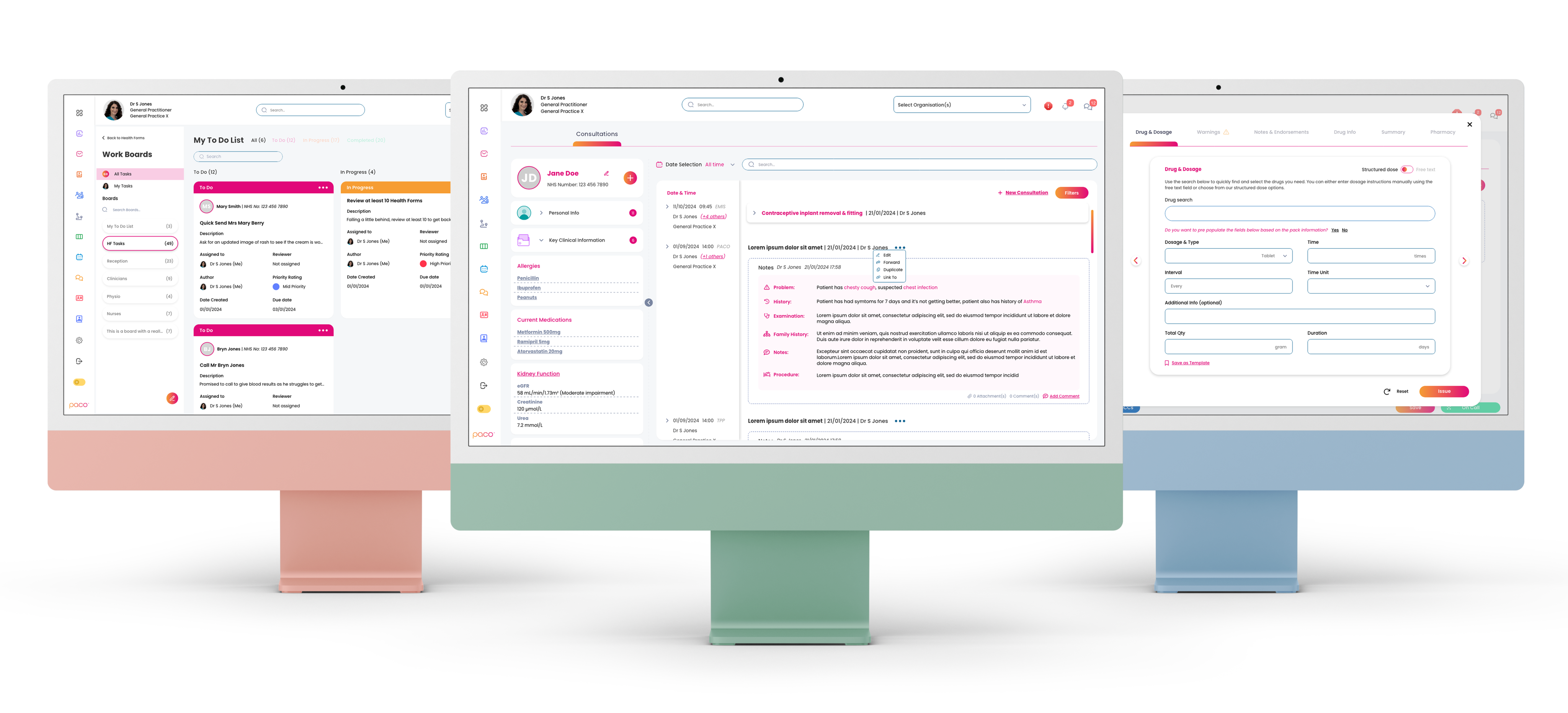
This is where Blinx comes in: modern infrastructure designed for neighbourhood health.
Early learning from neighbourhood trailblazers including Hillingdon and Cheshire & Merseyside is already shaping how this approach is being developed and applied in practice.
Blinx is building the operational layer that turns neighbourhood health from strategy into day-to-day practice.
- Joined-up real-time data and information across organisations.
- A shared, coherent understanding of the person, their family and their priorities in context.
- Mobile design enabling teams to work directly within the communities they serve.
- AI-enabled record summarisation that surfaces what matters, identifies risk earlier, and supports better decision-making.
Not information overload.
Shared understanding at the point of need.
Better decisions grounded in “what matters to you”.
But understanding alone is not enough.
Teams also need the ability to act together around that understanding.
That is where Blinx operationalises collaboration across neighbourhoods and systems – enabling permissioned working across health, social care, VCFSE partners, and local government – in and out of hours.
- Shared digital front door with triage and cross organisational booking at first contact, replacing fragmented navigation to services.
- Shared workflows, replacing endless referrals.
- Shared care planning, replacing disconnected episodes.
- Cross-organisational working with governance, roles, responsibilities and accountability embedded into daily practice.
- Ambient voice transcription, automated call-recall, coding and admin workflows, and AI-powered natural language search for faster analytics and reporting – reducing friction and administrative burden, so practitioners spend less time navigating processes and more time building relationships.
This is partnership working made operational, not aspirational.
And critically, the platform doesn’t stop at system coordination.
It changes how care is experienced by people and communities.
It enables coordinated, unified communication instead of fragmented interactions across services.
It supports proactive, personalised engagement at scale through case finding, targeted campaigns, tailored communication, translation, and the ability to connect directly into community-led support.
And it makes accurate, evidence-informed information easier to share – a major determinant of health.
That means people are better informed, better supported, and more confident to manage their own health and wellbeing.
This is where activation becomes real.
Not systems doing to people.
But systems working with people.
And when these elements come together, something fundamental changes.
Planning becomes more intelligent.
Risk becomes visible earlier.
Care becomes more human, more holistic.
Teams become more proactive.
People gain more agency in managing their own care.
Trust is rebuilt. People stay engaged.
And systems can finally learn in real time – understanding where need is emerging, where risk is rising, where ways of working need to adapt, and where resources can deliver the greatest value.
This is where “do with” becomes real.
Not coordination across disconnected digital systems.
But collaboration within one.
There is also a structural reality underneath all of this.
Health and care is saturated with point solutions – each solving a narrow problem while creating additional onboarding, integration, maintenance, and cost.
The result is duplication, fatigue, and fragmentation at scale.
A platform approach changes that.
It rationalises the digital landscape, reduces duplication and creates a shared operational layer for neighbourhood working — integrated into existing EHRs while also providing a full EHR for system partners where needed.
And importantly, it returns time, funding, and attention back into care itself – into neighbourhoods, prevention, and relational care.
But none of this works without credible partnerships.
Health is irreducibly local.
Neighbourhood health only works when it is built with local partners and communities, in context.
So Blinx is designed to adapt, to iterate, to dance with the system.
Co-designing. Co-producing. Co-delivering.
Closing the gap between rhetoric and operational reality.
Built on a simple but demanding principle: do with, not to.
Because ultimately this is about more than technology.
It is about creating the conditions for better decisions, better delivery, and better experiences at scale.
A system that sees people earlier.
Understands them more fully.
And acts together around what matters to them.
That is the opportunity.
The question now for us as leaders is whether we will act on it – together.
See PACO in Action
Ready to get started? We’ll show you exactly how PACO can fit your team.
Explore Our Customer Stories
See how organisations like yours are using PACO to connect systems and improve people’s care